
Building the Foundation for Trusted Conversational Analytics with Databricks Genie - Impetus

Building the Foundation for Trusted Conversational Analytics with Databricks Genie

Discover a practical framework to evaluate data, semantics, business context, and evidence readiness before scaling Genie adoption

Enterprise analytics is shifting from dashboard-led consumption toward conversational experiences. Business users increasingly expect direct answers to questions rather than navigating multiple reports, filters, and visualizations. Databricks Genie supports this shift by enabling natural-language interaction with governed enterprise data.

As adoption expands, organizations need to ensure that the underlying information is understandable, governed, and aligned with approved business meaning. While conversational access simplifies the user experience, the quality of answers still depends on the readiness of the data and context behind it.

In this blog, we explore:

  • Why enterprise readiness matters before scaling Genie
  • The four pillars of a Genie-ready foundation
  • How to benchmark answer quality and turn gaps into a remediation roadmap
Why readiness must come before Databricks Genie adoption

Successful Genie adoption depends on more than connecting data. A technically accessible dataset may still contain incomplete metadata, inconsistent business definitions, KPIs, unclear ownership, or insufficient evidence. These gaps can reduce answer consistency and make it difficult for users to understand why an answer should be trusted.

In practice, readiness gaps often look like this:

  • The same KPI, different answers: One metric is calculated differently across reports and teams.
  • Unclear sources of truth: Several datasets look valid, but none is clearly approved for the question.
  • Missing context: Business rules and definitions sit in documents or with individual teams instead of being connected to the data.

A readiness assessment helps identify and prioritize these issues before conversational analytics becomes embedded in operational and strategic decision-making.

What does “Genie-ready” actually mean?

Being Genie ready means that enterprise data can support business questions with the right quality, meaning, context, and evidence. The framework evaluates four foundational pillars:

PillarTechnical focus Adoption question 
Data readiness Discoverability, metadata, quality, ownership, lineage, keys, and join paths Can the required data be found, understood, connected, and governed? 
Semantic readiness KPIs, metric logic, dimensions, terminology, grain, and trusted interpretations Does the same question always carry the same approved business meaning? 
Context readiness Glossaries, business rules, processes, persona context, ontologies, and domain relationships Is enough business knowledge available to interpret each request correctly? 
Evidence readiness Policies, procedures, supporting documents, citations, and audit evidence Can important answers be traced to authoritative sources? 

Together, these four pillars provide a balanced view of whether Genie can produce responses that are relevant, consistent, explainable, and aligned with enterprise expectations.

How the Databricks Genie Context Readiness Framework works

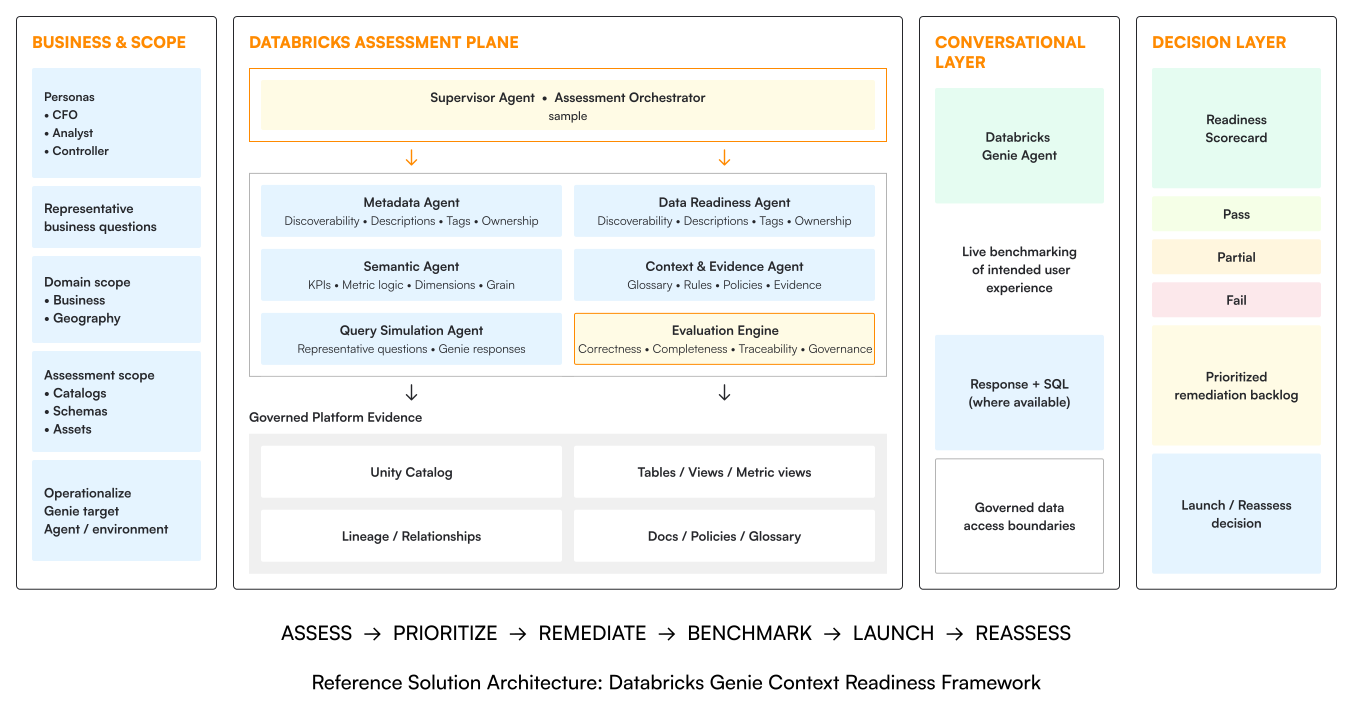
Impetus’ Databricks Genie Context Readiness Framework uses a multi-agent architecture that runs as an assessment workflow inside the customer’s Databricks environment. Using native platform services, it inspects governed assets, evaluates readiness signals, benchmarks representative questions, and publishes a prioritized report. The assessment follows six steps:

  • Scope: Selects the domain, persona, catalogs, schemas, and representative questions.
  • Harvest: Reads Unity Catalog metadata, descriptions, tags, relationships, lineage, and relevant profile signals.
  • Assess: Evaluates the four readiness pillars using deterministic checks and configurable evaluation logic.
  • Benchmark: Runs representative questions against the selected Genie Agent and inspects the generated responses and SQL, where available.
  • Prioritize: Translates findings into business impact, recommended fixes, effort bands, and sequencing.
  • Reassess: Repeats benchmarking after remediation to demonstrate improvement and support launch decisions.

Readiness isn’t a one-time milestone. It shifts as data products, business definitions, policies, and user questions evolve. The accelerator can be reused as a continuous control: rerun the benchmark after material changes, compare results with the baseline, and add any newly observed gaps to the improvement backlog.

How the Databricks Genie Context Readiness Framework works

A meaningful readiness result depends on a clearly defined assessment boundary.  Rather than evaluating the entire data estate at once, the framework is configured with the precise inputs needed to represent the intended business experience:

  • Business scope: Domain, intended users, decisions, and expected outcomes.
  • Question set: A representative benchmark covering common, complex, and governance-sensitive questions.
  • Data scope: Relevant catalogs, schemas, tables, views, metric views, and certified data products.
  • Context assets: Glossaries, KPI definitions, business rules, process documentation, policies, and ontologies.
  • Genie target: Genie Agents or the configured conversational environment used for live benchmarking.
  • Evaluation criteria: Correctness, completeness, semantic alignment, traceability, usability, and governance expectations.

This focused scope makes the findings actionable and every gap can be traced back to a specific user, question, or business outcome.

How the Databricks Genie Context Readiness Framework works

Each pillar is assessed against the selected domain, persona, and representative questions, so the findings reflect real business use rather than abstract technical standards. Here’s a snapshot of how it works:

 Data readiness

  • Inventories relevant assets and determines whether the required datasets are discoverable
  • Checks table and column descriptions, ownership, tags, refresh context, and certification signals
  • Inspects declared keys, inferred relationships, lineage, and join-path coverage
  • Reviews whether priority questions can be supported by available and suitable datasets

 Semantic readiness

  • Identifies KPIs, measures, dimensions, grains, filters, and approved formulas
  • Compares definitions across semantic assets, reports, teams, and documented business rules
  • Evaluates terminology coverage for the selected domain and persona
  • Validates whether test questions can be translated into consistent query intent

 Context readiness

  • Assesses glossary maturity, domain definitions, rules, exceptions, and process context
  • Evaluates mappings between business concepts and physical data assets
  • Reviews ontology or knowledge assets where entity relationships are important
  • Confirms that contextual assets are governed, owned, and reusable across use cases

 Evidence readiness

  • Identifies authoritative documents supporting definitions, policies, controls, and decisions
  • Assesses evidence coverage for the representative question set
  • Checks whether evidence can be connected to the relevant business concept or data result
  • Ensures document traceability for regulated or high-impact use cases

Benchmarking outcomes against real business questions

Static metadata checks provide only part of the readiness picture. A catalog can look complete, yet Genie can still struggle with real business questions. That’s why the framework adds a question-level benchmark against the intended Genie experience.The same representative questions can be executed consistently and evaluated against defined expectations.

Evaluation dimension What is reviewed 
Correctness Whether the response and query logic align with approved data and metric definitions. 
Completeness Whether essential filters, dimensions, time context, and requested details are included. 
Semantic alignment Whether business terminologies and KPIs are interpreted consistently. 
Traceability Whether the result can be linked to governed data and the required supporting evidence. 
Usability Whether the response is clear and actionable for the target persona. 
Governance fit Whether access boundaries, sensitive data expectations, and approved sources are respected.

From findings to an actionable remediation roadmap

A readiness assessment shouldn’t end with a score. With our Databricks Genie Context Readiness Framework, every finding becomes a remediation item with a clear owner, an actionable path, and a priority signal. Here’s what that looks like in practice:

Finding Business/Genie impact Recommended action Priority signal 
Key tables or columns lack descriptions Reduced discoverability and ambiguous query intent Add governed descriptions and ownership metadata High when used by priority questions 
The same KPI has multiple formulas Inconsistent interpretation across users Approve one definition and publish reusable semantic logic High for executive or regulated metrics 
Join paths are inferred but not declared Higher ambiguity in multi-table questions Define trusted relationships or curated views Based on question coverage 
Policy evidence is not linked to business concepts Limited traceability for evidence-sensitive answers Map authoritative documents to terms, controls, or metrics High for compliance use cases

Delivering business value for teams across the enterpriseGenie readiness isn’t only a data engineering task. It brings business, platform, governance, and engineering teams together around a shared definition of trusted answers.

For business and account teams For data and AI engineering teams 
A clear answer to whether the selected use case is ready today A focused backlog for metadata, semantic, context, and evidence improvements 
A fact-based adoption roadmap tied to real business questions Traceability from individual findings to affected assets and questions 
Visibility into trust, governance, and evidence requirements A reusable benchmark for regression testing after changes 
A repeatable method for expanding adoption across domains A common readiness vocabulary across platform, domain, governance, and business teams

From findings to an actionable remediation roadmap

Databricks Genie provides a self-service analytics experience for enterprise-wide teams. Impetus’ Genie Context Readiness Framework helps you evaluate whether its selected domain, data products, business semantics, contextual assets, supporting evidence, and representative questions are ready to support that experience today.

By combining platform inspection, business-aligned scoring, live question benchmarking, and a prioritized remediation roadmap, the accelerator turns readiness from an assumption into an evidence-led adoption decision. This helps teams start with the right scope, invest where it matters, and scale Genie with confidence.

Learn more about how our work can support your enterprise