

| 30% cost reduction | 12,300+ legacy queries and views transformed | Context-rich data products to accelerate enterprise AI | Profitability intelligence unlocked contract-level insights |
The business case for modernization to Databricks
One of Latin America’s biggest financial institutions operated legacy data infrastructure comprised of tightly coupled pipelines that were difficult to scale, maintain, and adapt to evolving business needs. Their fragmented technology landscape—built across Oracle, Sybase IQ, SAP Business Objects, Oracle Warehouse Builder (OWB), and other legacy systems—created significant operational complexity. The constraints made it difficult to generate trusted business insights, accurately measure profitability and risk, optimize collections, maintain regulatory traceability, and scale AI initiatives.
Key challenges:
- Monolithic pipelines: Large, tightly coupled processing flows constrained scalability and made change risky.
- Fragmented logic: Business rules were distributed across databases, Java programs, ETL tooling, and Excel/Visual Basic macros.
- Delayed decisions: Slow data availability and reporting affected monthly business processes, including collections and recovery.
- Limited profitability visibility: Lack of granular product- and contract-level insights made it hard to identify negative profitability and take remedial action.
- Inconsistent business definitions: Data was defined and understood differently across domains and departments, hindering enterprise-wide decision-making.
- Unallocated shared costs: Branch and cost-center expenses could not be consistently attributed to the products, customers, and contracts that consumed them.
The client needed more than a lift-and-shift migration. They required a strategic modernization program that could preserve complex banking logic while rebuilding the underlying data platform and the business data products that depended on it.

Unified massive legacy systems into a single, scalable Databricks Lakehouse foundation that powered real-time analytics and agentic AI workloads.
Unlocking an intelligent future on Databricks
Partnering with Databricks and Impetus, the bank transformed fragmented data and monolithic pipelines into trusted, enterprise-wide intelligence. Business teams could seamlessly access governed data, fueling better decisions and faster agentic AI innovation.
Business benefits:
- Real-time analytics at scale: Enabled continuous, event-driven intelligence across loans, credit cards, and other banking domains.
- Granular profitability insights: Unlocked accurate contract-level profitability insights for the first time, enabling the bank to enhance their bottom line.
- Massive cost savings: Sunset legacy technologies, reduced rising licensing costs, and enhanced operational efficiencies.
- Precise cost allocation: Enabled accurate expense distribution across products, branches, customers, segments etc. through cloud-based cost allocation.
- Improved recovery outcomes: Empowered collection executives to identify and act on recovery opportunities faster.
- Strengthened operational resilience: Enhanced the bank’s DR strategy and reduced RPO & RTO to under four hours.
- Built a banking semantic core: Standardized business definitions and relationships across domains, grounding insights in a single truth and enabling cross-domain interoperability.
- Context-rich data products: Created lineage-aware data products for accelerating AI-driven fraud detection, hyper-personalization, post-call analytics, NL insights etc. with Databricks Genie.
- Agentic AI readiness: Data warehouse modernization became the first step in the bank’s journey towards agentic AI enablement on Databricks.
Achieved a 30% reduction in costs by retiring end-of-life technologies, closing major process gaps, and lowering rising licensing costs.
How Databricks and Impetus accelerated and simplified the modernization journey
By leveraging Impetus’ ontology-led modernization solution, LeapLogic™ Suite, and the unmatched capabilities of Databricks Lakehouse, the bank reduced effort, saved cost, eliminated risk, and laid a robust foundation for an AI-native future.
Solution highlights:
Production-grade, resilient pipelines: Databricks enabled idempotent pipelines that supported critical banking operations and improved key DR metrics (RPO & RTO) to under 4 hours.
Intelligent data estate assessment: LeapLogic Assess identified and eliminated 350+ redundant processes at record speed, accelerating migration, reducing technical debt, and ensuring optimization & production-readiness on Databricks.
Automated modernization at scale: LeapLogic Migrate seamlessly transformed 110 GB of data, 9300+ complex queries, 3000+ legacy views, and hundreds of stored procedures, scheduling jobs, tables, etc. across Oracle and Sybase IQ to Databricks-native equivalents with 100% accuracy.
Trusted, AI-ready enterprise data: Established Source and Gold data layers to deliver clean, reliable data across the enterprise.Rather than mechanically copying legacy scripts, data models and pipelines were redesigned, creating a trusted foundation for downstream data products.
Advanced analytics support: Rebuilt a fragmented, spreadsheet- and Visual Basic macro-dependent process as a unified data warehousing capability—delivering timely, consolidated data for collections and recovery teams to act on. Databricks Unity Catalog was leveraged to organize and govern the migrated data efficiently.
Profitability data product: Converted complex profitability and cost-allocation logic into a governed, reusable data product supporting contract-level profitability, RAROC analysis and identification of underperforming relationships.
Collections Intelligence: Unified customer, contract, exposure, payment and recovery context to help collections teams prioritize opportunities and act on trusted, timely information.
Regulatory traceability: Preserved the lineage of banking calculations, business rules and sensitive data during modernization to strengthen explainability, access governance, audit readiness, and controlled AI consumption.
Modern, self-service DevOps: Databricks Lakehouse integrated seamlessly with new-age CI/CD tools to accelerate development, testing, and releases while empowering teams with self-service capabilities.
Embedded governance: Unity Catalog standardized access controls and enabled built-in governance across multiple data domains and tables, plugging compliance and traceability gaps that existed in the legacy environment.
Operational independence: Impetus equipped the bank’s teams to operate and scale the platform independently by providing structured documentation, live demonstrations, and knowledge enablement sessions.
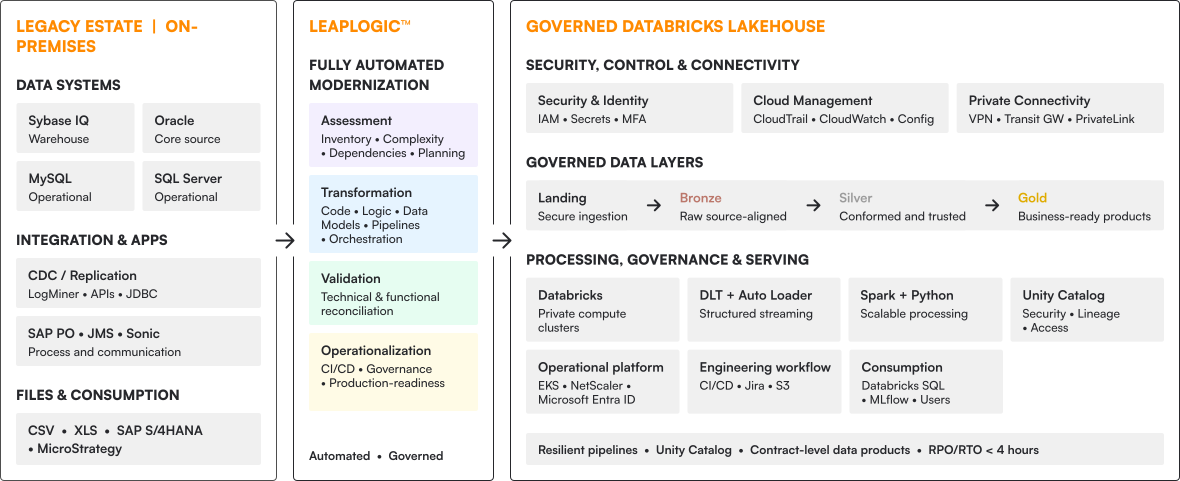
From a monolithic, legacy stack to an AI-ready data foundation for intelligent banking
Delivered trusted enterprise data across key banking domains, including loans, credit cards, profitability, and collections – accelerating AI innovation and elevating business outcomes.
Conclusion
With a unified semantic core and future-ready data estate in place, the bank is now well positioned to take full advantage of the Databricks Data Intelligence Platform, including Databricks AI/BI Genie and Agent Bricks. Modernization has helped unlock several strategic AI-driven banking use cases, including fraud detection, hyper-personalization, post-call analytics, next-best-actions, and infrastructure monitoring among others.