Enabling intelligent, risk-free Teradata modernization
Teradata has supported critical enterprise decisions for decades. Its accumulated business logic is an asset worth carrying forward. A successful transition must account for the surrounding processes as well as the database.
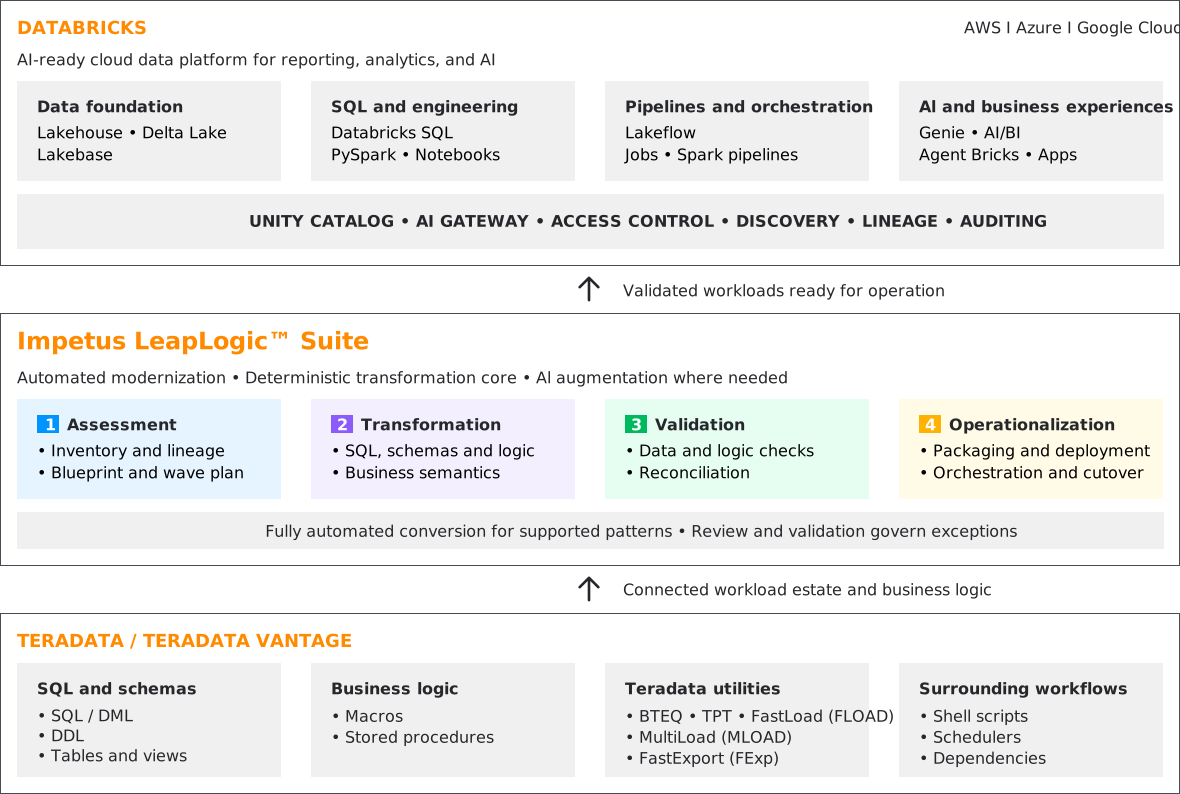
LeapLogic modernizes Teradata and Teradata Vantage estates, covering SQL and DML, DDL and schemas, macros, stored procedures, BTEQ, FastLoad (FLOAD), MultiLoad (MLOAD), FastExport (FExp) and Teradata Parallel Transporter (TPT), alongside Shell scripts and associated orchestration. This breadth helps prevent a converted query from becoming an isolated deliverable while the business process remains dependent on Teradata.
Start with outcomes the business will notice
Define the modernization case around a priority business process, such as daily revenue reporting, customer profitability or inventory planning. Next, connect the technical changes to measurable improvements:
- Earlier decisions: Shorter data preparation and processing windows can make trusted information available sooner.
- Lower operating cost: Automating repetitive migration work and retiring eligible legacy capacity can reduce delivery effort and ongoing expense.
- Business continuity: Reconcile critical calculations and outputs so teams can keep using familiar, trusted measures.
- Greater capacity: Give analytics and AI teams governed data enriched with business definitions and relationships, so new initiatives are built on a shared understanding of the business.
Databricks provides the destination architecture: Lakehouse and Delta Lake for data, SQL and PySpark for processing, Lakeflow for pipelines and orchestration, and Unity Catalog for governance. The broader stack includes Lakebase, Genie, AI/BI, Agent Bricks, and Unity AI gateway, extending the foundation to operational applications and AI experiences. Services are selected according to workload requirements and business priorities.
Modernization economics should always include a finite transition period. Running both platforms indefinitely can absorb expected savings. A phased plan that links migration, acceptance, and legacy retirement gives sponsors a more credible view of when tangible benefits would materialize.
Choose a proven migration partner
Impetus LeapLogic Suite has demonstrated its modernization capabilities across complex enterprise environments. For a leading global entertainment company, it achieved 85% automated transformation of Teradata and SAP BODS workloads, while establishing a strategic context engineering foundation for AI. The engagement went beyond simple code conversion to deliver operationally ready workloads across an interconnected data estate. It demonstrates LeapLogic’s ability to manage complex, end-to-end modernization programs while laying the groundwork for AI adoption. Results will vary based on each enterprise’s migration scope, complexity, and success criteria.
Impetus’ Databricks credentials reinforce this delivery depth:
- Partner recognition: Databricks Gold Partner, with three consecutive ‘Partner of the Year’ wins: Migration Partner in 2023 and 2024, and Enterprise Data Warehouse Partner in 2025. Impetus is also a proud Databricks Lakebase Launch Partner.
- Specialized expertise: Brickbuilder specializations in Migrate & Modernize; Data Warehouse Migrations; Security & Governance; as well as Financial Services; Manufacturing, Transport & Energy; Healthcare & Life Sciences; and Retail, Consumer Goods and Travel.
Follow a structured modernization roadmap
Here’s a glimpse of how LeapLogic implements a pragmatic, multi-step approach that covers the end-to-end modernization journey and ensures long-term success:
- Assessment reduces migration scope and improves planning: LeapLogic inventories the data estate, analyzes dependencies and workload complexity, and identifies optimization opportunities. These insights inform the target architecture, effort estimates, and phased migration roadmap. Prioritizing complete business processes helps accelerate value realization and enables earlier retirement of legacy dependencies.
- Transformation preserves logic and enhances execution: LeapLogic transforms Teradata artifacts into Databricks equivalents, adapting schemas, SQL, procedural logic, and loading workflows to the target architecture. Deterministic rules ensure consistent, repeatable conversions for supported patterns across the estate, while selective AI augmentation handles complex exceptions under appropriate review and validation. This reduces manual rewriting and delivery effort, allowing engineers to focus on architecture, optimization, and complex business requirements. Beyond code conversion, LeapLogic’s semantic and ontology-led modernization preserves critical business definitions, calculation logic, and relationships. For example, a revenue metric may exclude returns or recognize sales only after fulfillment. Preserving such definitions ensures downstream workloads and AI agents retain the business context embedded in legacy systems. Rules-based conversions execute without LLM inference or token costs, while AI augmentation addresses gaps without requiring model calls for every conversion. This helps control costs and maintain a consistent transformation approach across migration waves.
- Validation establishes confidence in the results: LeapLogic automates data and business logic validation, including granular comparisons and integration testing. This helps verify that the transformed workloads produce the expected business results. Teams investigate discrepancies and reconcile outputs before acceptance. For sponsors, this creates evidence for release decisions, particularly where revenue calculations, customer measures or operational reports depend on precise transformations.
- Operationalization turns converted workloads into a running business service: LeapLogic supports executable packaging, orchestration, deployment automation, performance optimization and cutover planning – end-to-end. Workloads must meet agreed service levels in their operating environment, with appropriate scheduling, monitoring and recovery arrangements. A phased cutover links technical readiness to business acceptance. Legacy capacity can then be retired as dependencies are cleared, helping turn the modernization business case into realized savings.